Premium Wheel Stop – 1650mm

This video provides an overview of our most commonly supplied wheel stop, the Premium Wheel Stop (1650mm), explaining where it’s typically used, how it’s built, and how it’s installed.

If you’d rather read than watch, here’s the key information.

What this wheel stop is used for

The 1650mm Premium Wheel Stop is commonly used in car parks and vehicle bays to provide a clear stopping point for vehicles. Its main roles are:

  • Preventing vehicles from overshooting parking spaces

  • Protecting assets such as shop fronts, walls, and structures

  • Reducing the risk of vehicles entering pedestrian walkways

It’s a practical solution anywhere vehicles need a physical limit without relying on driver judgement alone.

When a wheel stop makes sense

A simple rule of thumb:

If there’s nothing physically stopping a vehicle from rolling past its parking space and:

  • Hitting a building or asset, or

  • Entering a pedestrian area

…that’s a strong indicator a wheel stop should be installed.

Wheel stops are particularly helpful for drivers reversing into parks, as it provides a clear touch point to indicate when the vehicle is correctly positioned within the bay.

Material, weight, and handling

This wheel stop:

  • Weighs 13.5kg

  • Is made from heavy-duty recycled plastic

  • Is durable, but still lightweight enough for one person to install

Compared to concrete wheel stops, this makes handling and installation simpler while still providing solid impact resistance for everyday car park use.

Limitation to note:
If you’re managing heavy vehicles such as trucks or buses, this model may not be suitable. In those situations, we recommend a heavy-duty wheel stop instead.

Design features that improve durability

On the underside of the wheel stop, you’ll see reinforcing support structures that give it strength without adding unnecessary weight.

At each end, there’s additional grid reinforcement. This is where vehicle tyres (especially cars and utes) are most likely to make contact. The extra support helps reduce end crumbling — a common issue with lighter-weight rubber alternatives.

Visibility in low-light conditions

Each wheel stop includes eight reflective yellow chevrons (4 each side).

These improve visibility at night or in low-light environments when headlights reflect off the surface, helping drivers clearly see the stopping point.

Size options and when to consider alternatives

The 1650mm version suits standard car parks. However, you may want to consider other options if:

  • You have wider parks, such as accessible (disability) car parks

  • Larger vehicles like utes are common

In these cases, the 1830mm wheel stop may be a better fit.

Fixing points and installation

The 1650mm wheel stop has three fixing points — one at each end and one in the centre.

We supply different fixings depending on the surface:

Asphalt installation

  • M12 x 300mm rebar spikes

  • Inserted through the fixing holes and driven into the asphalt using a sledgehammer

Concrete installation

  • M12 x 150mm concrete screws

  • Installed using a socket wrench or impact driver

Need help choosing the right option?

Wheel stops aren’t one-size-fits-all. Vehicle type, bay width, surface, and surrounding risks all matter.

If you need help selecting the right wheel stop for your site, our team can help you choose the right option for your situation.

Premium Wheel Stop – 1830mm

This video provides an overview of our Premium Wheel Stop (1830mm) — a wider-format wheel stop designed for larger car parking spaces.

If you’d prefer to read rather than watch, the key points are outlined below.

Where the 1830mm wheel stop is typically used

The 1830mm Premium Wheel Stop is most commonly used in:

  • Wider car parking spaces, such as accessible (disability) parks

  • Sites where larger vehicles, like utes, regularly use standard parking bays

The additional width helps ensure the wheel stop aligns properly with wider wheel tracks and provides consistent stopping protection across the full bay.

When a wheel stop makes sense

A simple rule of thumb:

If there’s nothing physically stopping a vehicle from rolling past its parking space and:

  • Hitting a building or asset, or

  • Entering a pedestrian area

…that’s a strong indicator a wheel stop should be installed.

Wheel stops are particularly helpful for drivers reversing into parks, as it provides a clear touch point to indicate when the vehicle is correctly positioned within the bay.

Material, weight, and handling

This wheel stop:

  • Weighs 14kg per unit

  • Is made from heavy-duty recycled plastic

  • Is durable, but still light enough for a single person to install

It offers a practical balance between strength and ease of handling, especially when compared with heavier options like concrete wheel stops.

Limitations to be aware of:

Design features that support wider vehicles

On the underside of the wheel stop, you’ll see reinforcing support structures that give it strength without adding unnecessary weight.

At each end, there is additional reinforcement designed specifically to handle contact from wider wheelbase vehicles. This helps prevent end damage or crumbling — a common issue when narrower or lighter-weight rubber alternatives are used in bays frequented by utes.

Visibility in low-light conditions

Each wheel stop includes eight reflective yellow chevrons (4 each side).

These improve visibility at night and in low-light environments when vehicle headlights reflect off the surface.

Fixing points and installation

The 1830mm Premium Wheel Stop has three fixing points — one at each end and one in the centre.

We supply different fixings depending on the surface:

Asphalt installation

  • M12 x 300mm rebar spikes

  • Inserted through the fixing holes and driven into the asphalt with a sledgehammer

Concrete installation

  • M12 x 150mm concrete screws

  • Installed using an impact driver or socket wrench

Need help choosing the right wheel stop?

Wheel stops aren’t one-size-fits-all. Vehicle type, bay width, surface, and surrounding risks all matter.

If you need help selecting the right wheel stop for your site, our team can help you choose the right option for your situation.
From Tripping Hazard to Safe Walkway at Kilcoy Global Foods

Client: Kilcoy Global Foods
Location: Bells Creek Facility, Sunshine Coast, Queensland, Australia

Established as a family-owned meat wholesaler in 1953, Kilcoy Global Foods has since grown into one of the world’s leading producers of Australian food solutions.

Over several decades, the business has steadily expanded its geographical spread. One of its latest moves has been the introduction of a purpose-built coldstore warehouse in the Sunshine Coast suburb of Bull Creek.

For Kilcoy, running a high-functioning facility depends heavily on providing maximum protection for its people, equipment, and structures, without bottlenecking operations.

When the safety controls put in place during the build weren’t adequately addressing on-site risks, Vanguard was approached to assess the site and recommend safer, more efficient solutions.

Client Challenge:

When the Bells Creek facility was first built, a steel box-section barrier was installed internally to create a delineated walkway and separate pedestrians from forklifts and other material-handling equipment (MHE). However, the barrier quickly presented some significant issues.

These included:

  • Forklifts hitting barriers, causing the anchors to rip out of the concrete. This damaged the barriers and the concrete surface, resulting in costly repairs and operational downtime.
  • Pedestrians kept stepping over the barrier into operational zones.
  • The barrier became a tripping hazard for pedestrians.
  • The barrier configuration (low height, no impact protection) provided insufficient physical separation between pedestrians and forklifts.

As a result, pedestrians were exposed to forklift and MHE impacts, the risk of injury increased, and the cost to repair the barrier and the damaged concrete underneath was significant.

Solutions Offered

After connecting with the team at Kilcoy, our AU Workplace Safety Division Manager, Jared Muller, headed to Bells Creek to meet with Kilcoy’s safety manager and walk the site to better understand the situation.

Seeing these risks firsthand and speaking with key stakeholders enabled us to develop a plan to significantly improve the site’s safety and efficiency. Our recommendation was as follows, and was adopted following consultation and careful consideration of the project budget.

Flexible, Energy-Absorbing Barriers

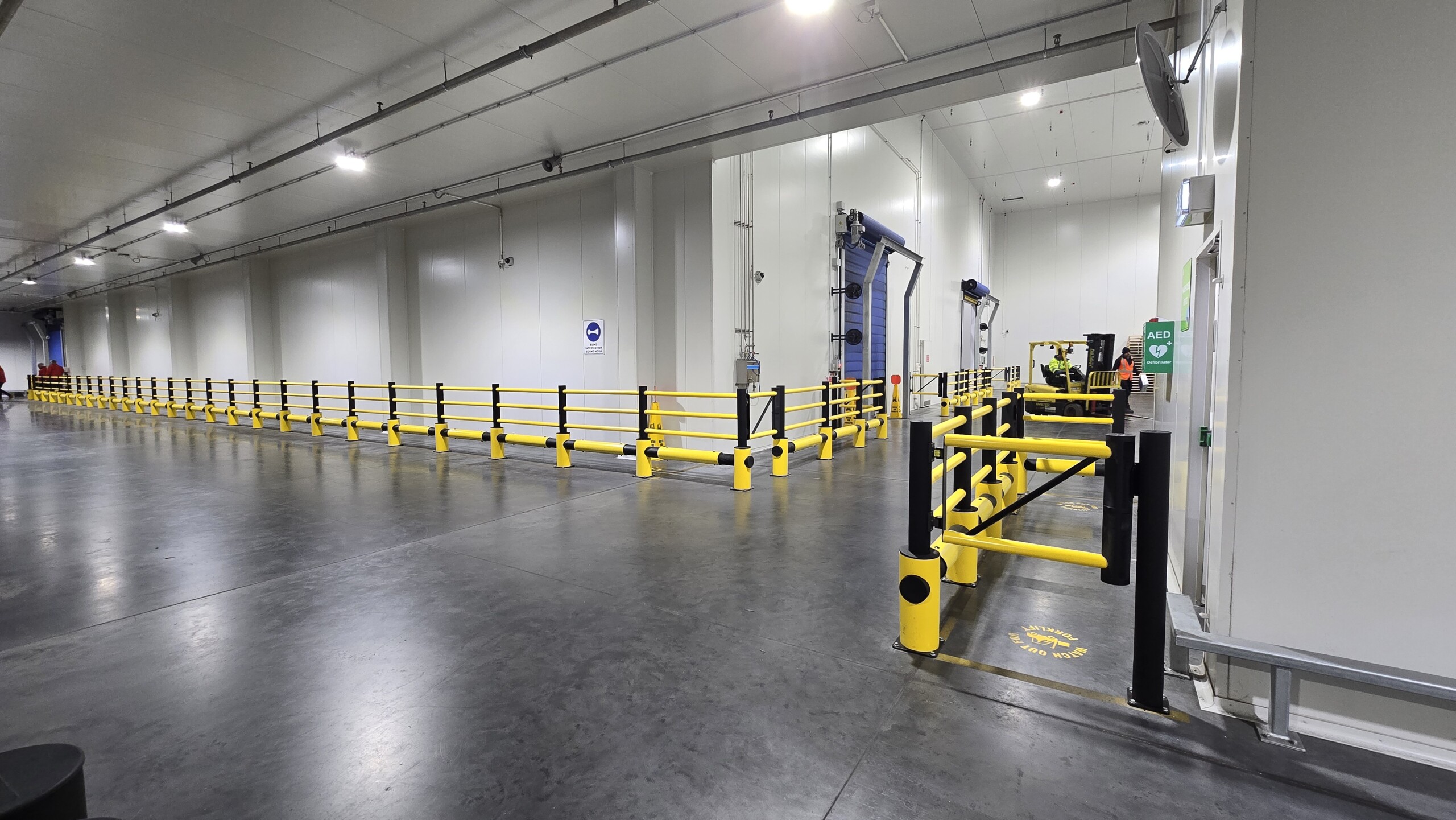
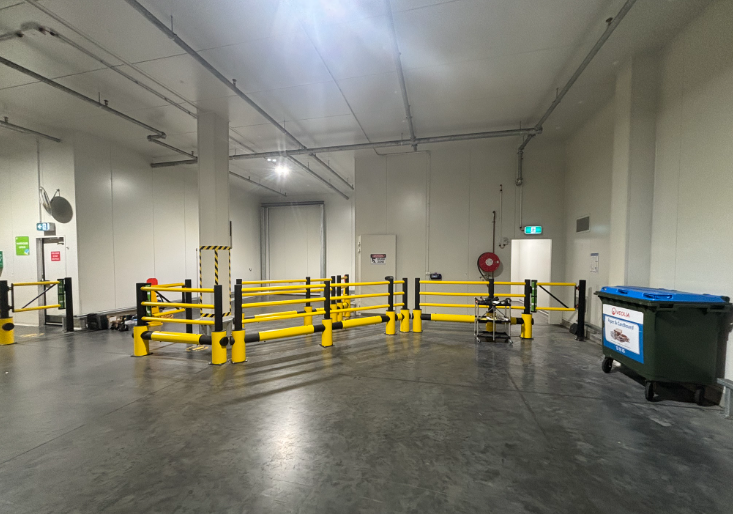
To create a clear, impact-rated walkway in areas with no physical protection for pedestrians from forklifts, Kilcoy installed a series of flexible, energy-absorbing barriers.

Slim in style, the barrier freed up a whole lot of operational space that would have been lost if a bulky W-Beam Barrier had been installed instead. At 1 metre high, it provided physical protection for pedestrians moving around the site, in case a forklift or other vehicle encroached on the walkway. It also prevented pedestrians from stepping over the existing steel box-section barrier and into the line of traffic. 

Impact-rated to Match Risk

The barrier’s flexible material is rated to withstand impacts from forklifts and, when struck, is designed to absorb energy and return to its original shape. As a result, there is less pressure on the barrier anchors and a greatly reduced likelihood that the barrier will rip out of the concrete when hit.

Cool Storage-Friendly

The flexible material will also not chip or dent, which is essential for food manufacturing and cold storage environments where moisture is present, and food safety is paramount.

Reduced Operational Footprint

In bright safety yellow for clear visibility, the slim design of the flexible barriers allowed Kilcoy to keep operational footprint low—a game-changer for tight spaces with lots of movement.

The Outcome

Kilcoy’s experience is not an unfamiliar one. Too often, new builds are constructed without the appropriate safety controls to match site-specific risks. Failing to do so in the first instance means putting people and assets at risk, incurring additional costs to uninstall and reinstall a more effective system, and experiencing more operational downtime.

However, by identifying that the systems in place were inadequate early on, Kilcoy was able to engage our team at Vanguard to help them develop a better solution. By investing in flexible barriers to create pedestrian walkways in high-risk areas throughout the site, the team now have the assurance that their people and assets will be protected. Long-term, they will also significantly reduce the costs that come with maintenance and operational downtime.

How Can We Help?

If you need support mitigating safety risks and maximising efficiency on your site, we’re here to help. Get in touch with our team so we can understand your situation and work together to develop a comprehensive plan within your budget.

Unsure how our process works? Check out Vanguard’s 5-Step Safety Design Video.

To learn more about our barrier systems, you can check out our full range here.

Kilcoy Global Foods barriers